
Key Takeaways
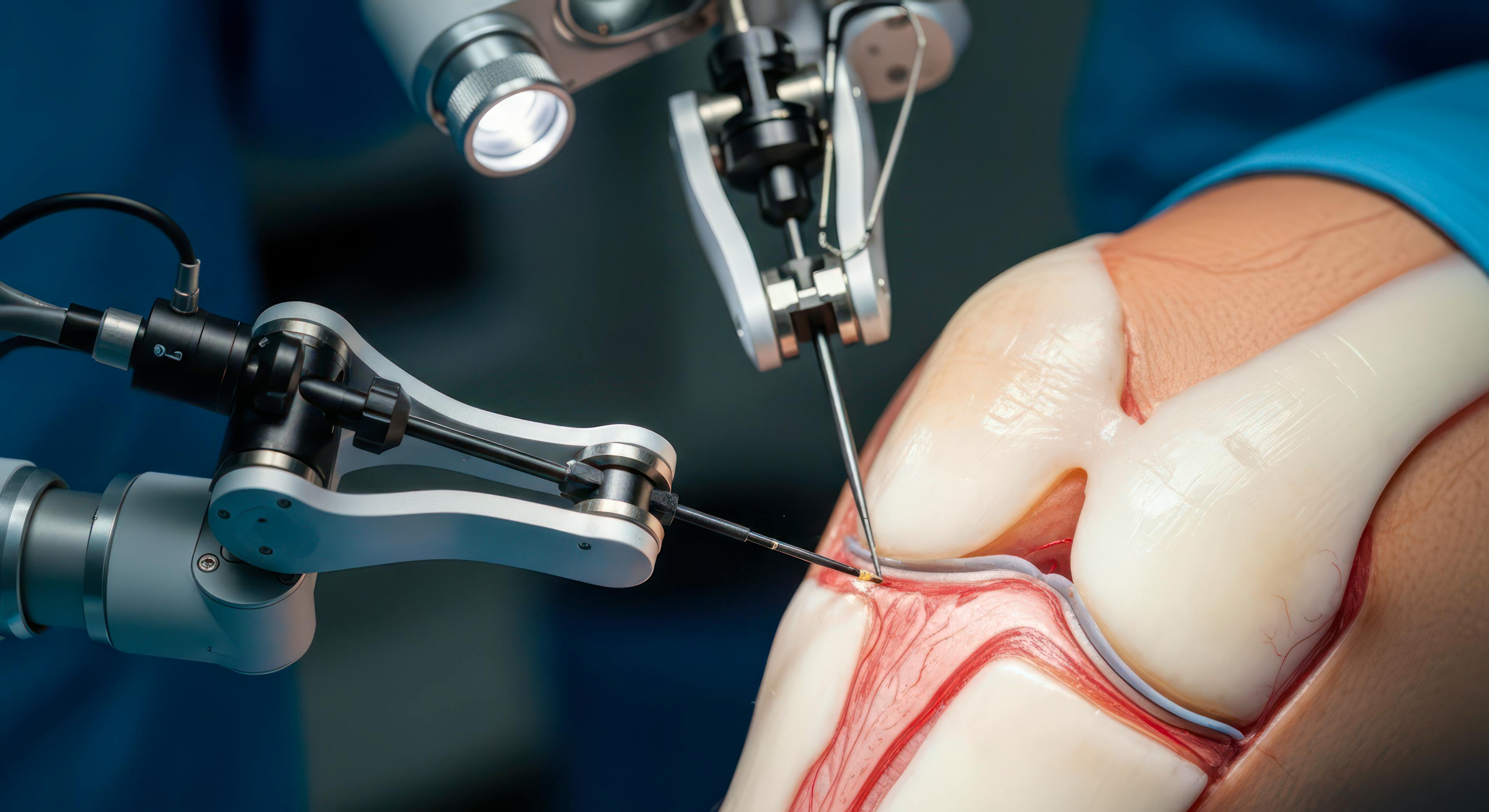
Robotic knee replacement uses advanced planning and robotic-arm assistance to help the surgeon position knee implants with greater precision.
The surgeon remains in control throughout the procedure; the robotic system does not perform the surgery independently.
MAKO robotic assistance may be used for partial or total knee replacement, depending on the location and severity of joint damage.
Recovery and long-term results depend on factors such as overall health, rehabilitation, implant selection, and surgeon expertise.
Personalized MAKO-assisted Knee Replacement from an Experienced Orthopedic Surgeon
Robotic knee replacement combines advanced imaging, personalized surgical planning, and robotic-arm assistance to help an orthopedic surgeon position knee implants with greater precision.
At CLS Health, Kenneth Brooks, MD, uses the MAKO robotic system to perform partial and total knee replacement when appropriate. The technology creates a patient-specific 3D model of the knee and provides real-time guidance during surgery, while Dr. Brooks remains in control of every step.
Robotic assistance is one part of the overall treatment approach. Outcomes also depend on the severity of arthritis, implant selection, surgeon experience, overall health, and participation in rehabilitation.
What Is Robotic Knee Replacement?
Robotic knee replacement is a surgical approach that uses advanced robotic technology to assist the surgeon before and during knee replacement surgery. Using detailed imaging, the system creates a 3D model of your knee to help plan implant size, positioning, and alignment.
Robotic assistance may be used for a partial knee replacement, which replaces one damaged portion of the knee, or a total knee replacement, which replaces the damaged surfaces across the joint.
It’s important to know that the surgeon is always in full control. The robotic system is a precision tool that helps guide bone preparation and implant placement based on the surgical plan.
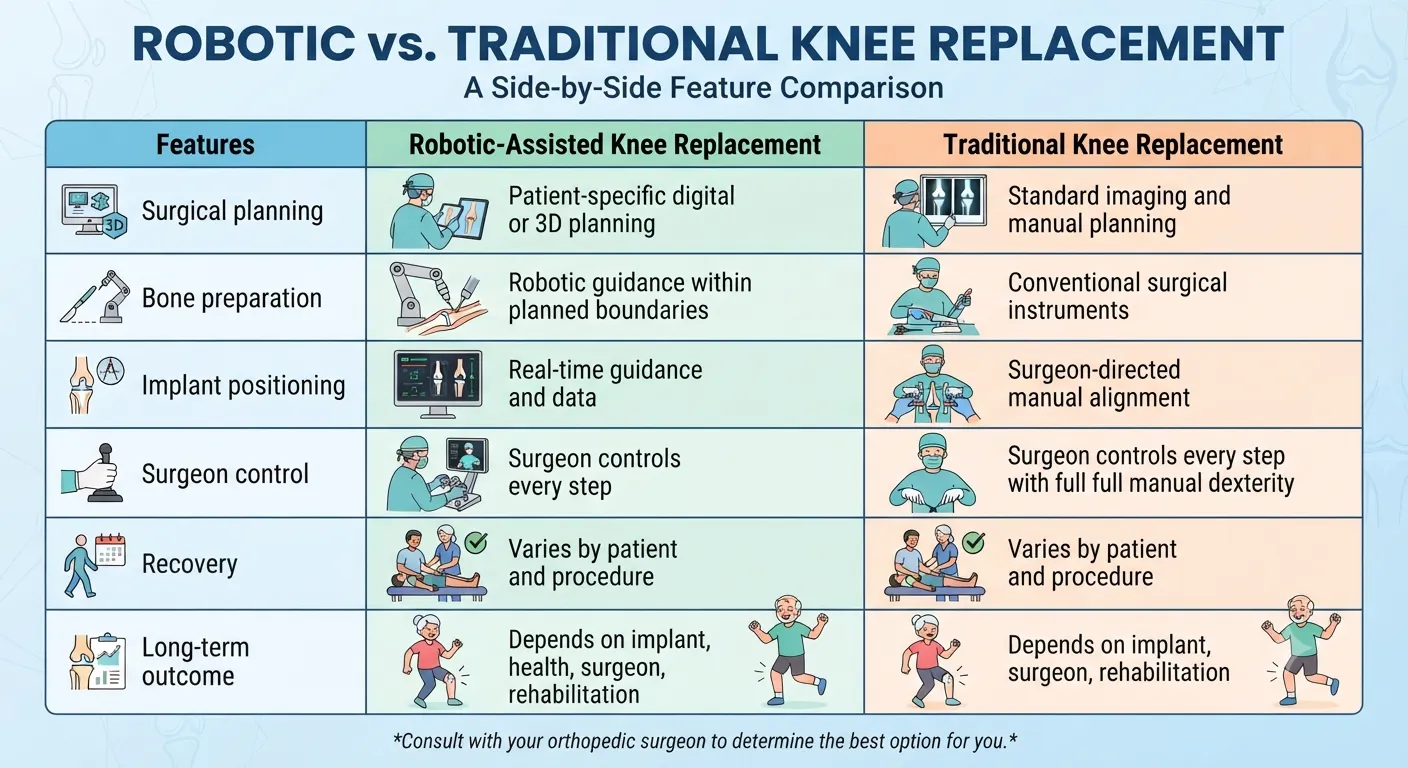
Compared with conventional knee replacement instrumentation, robotic-assisted surgery provides more individualized preoperative planning, real-time surgical data, and additional guidance for bone preparation and implant positioning.
Benefits of Robotic-Assisted Knee Replacement
Potential advantages may include:
- Patient-specific 3D surgical planning
- Precise implant positioning and alignment
- Real-time assessment of joint balance
- Controlled bone preparation using planned boundaries
- Less disruption to some surrounding tissues
- Improved early function for some patients
Important considerations:
- Robotic assistance does not guarantee a better outcome.
- Not every patient needs or qualifies for robotic-assisted surgery.
- Recovery varies based on health, procedure type, and rehabilitation.
- Surgeon experience and appropriate patient selection remain essential.
The MAKO Robotic Knee Replacement System
The MAKO system uses a CT scan to create a 3D model of your knee before surgery. Your surgeon uses this model to plan the size, position, and alignment of the implant based on your anatomy.
During surgery, the robotic arm provides haptic guidance and real-time information to help the surgeon prepare the bone and place the implant within the planned boundaries. The surgeon controls the robotic arm and may adjust the plan based on joint movement and soft-tissue balance.
MAKO technology may be used for partial or total knee replacement when clinically appropriate.
Robotic vs. Traditional Knee Replacement
Both approaches can provide effective pain relief and improved function. Your surgeon will recommend the method most appropriate for your knee anatomy, arthritis severity, and treatment goals.
Who May Be a Candidate for Robotic Knee Replacement?
Robotic-assisted knee replacement may be considered for adults with:
- Moderate to severe osteoarthritis
- Bone-on-bone joint degeneration
- Persistent knee pain that limits walking, stairs, work, or daily activities
- Stiffness or reduced range of motion
- Knee deformity or instability
- Symptoms that have not improved with appropriate nonsurgical treatment
A physical examination and weight-bearing X-rays help determine the extent and location of joint damage. Additional imaging, including a CT scan, is used for MAKO surgical planning after knee replacement has been recommended.
Is Knee Replacement the Right Next Step?
Dr. Brooks can evaluate your knee arthritis, review your imaging, and explain whether nonsurgical treatment, partial knee replacement, or total knee replacement may be appropriate.
FAQs
Robotic assistance can improve surgical planning and implant-positioning accuracy, but it is not automatically better for every patient. Outcomes also depend on arthritis severity, overall health, implant selection, surgeon experience, and rehabilitation.
Some patients may experience less pain or faster early function, but results vary. Robotic assistance does not eliminate postoperative pain, and patients still need pain management, activity progression, and physical therapy.
The length of surgery varies depending on whether a partial or total knee replacement is performed and the complexity of the case. Your surgeon can give you a more personalized estimate during preoperative planning.
Medicare may cover knee replacement when it is medically necessary and documentation requirements are met. Coverage and out-of-pocket costs can vary, so benefits should be verified before surgery.
Many patients begin walking shortly after surgery and gradually resume daily activities over several weeks. Strength, mobility, and swelling may continue improving for several months.
No. The orthopedic surgeon performs and controls the procedure. The robotic system provides planning information and guidance to help execute the surgical plan.
Partial vs. Total Robotic Knee Replacement
A partial knee replacement may be appropriate when arthritis is limited to one compartment of the knee and the remaining joint structures are healthy. A total knee replacement may be recommended when damage affects multiple areas of the joint.
MAKO robotic assistance can support both procedures. Your surgeon will determine which approach fits the location and severity of your arthritis.
What to Expect During Robotic Knee Surgery
The length of robotic knee replacement surgery varies based on whether a partial or total replacement is performed, the complexity of the case, and individual patient factors.
Steps often include:
- CT-based imaging and surgical planning
- Anesthesia and surgical preparation
- Registration of the knee anatomy
- Robotic-guided bone preparation
- Trialing and balancing the joint
- Implant placement
- Closure and recovery monitoring
Many patients go home the same day or after a short hospital stay, depending on overall health and recovery progress.
Recovery After Robotic Knee Replacement
Recovery is different for every patient and depends on the type of replacement, age, overall health, home support, and participation in physical therapy.
Early Recovery (First 1–2 Weeks)
- Walking with assistance the same day or next day
- Pain managed with medications and ice
- Focus on safe movement at home
Week-by-Week Improvements
- Gradual improvement in knee flexibility and strength
- Structured physical therapy schedule
- Swelling and stiffness steadily decrease
Long-Term Recovery
- Many patients gradually resume routine daily activities over several weeks, while strength, endurance, and swelling may continue improving for several months.
- Strength and endurance continue to improve over several months
- Long-term outcomes depend on rehab participation and overall health
Meet Your Robotic Knee Replacement Surgeon
Kenneth Brooks, MD – Orthopedic Surgery, Sports Medicine, and Joint Replacement & Restoration
Dr. Kenneth Brooks is a board-certified orthopedic surgeon specializing in sports medicine, joint replacement, and joint preservation. He performs MAKO-assisted partial and total knee replacement and develops personalized treatment plans based on each patient’s knee damage, health, activity level, and recovery goals.
Dr. Brooks has served in orthopedic leadership and academic roles and has extensive experience treating complex knee conditions throughout the Houston area.
Robotic Knee Replacement Near Houston
CLS Health provides robotic knee replacement consultations and follow-up care for patients throughout Greater Houston, including:
- Sugar Land and Southwest Houston
- Webster, Clear Lake, and Bay Area Houston
- Friendswood
- Pearland
- Cypress
Surgical location and eligibility will be discussed during your consultation.
Insurance and Robotic Knee Replacement Cost
Insurance coverage generally depends on whether knee replacement surgery is considered medically necessary under the patient’s plan. Medicare may cover total knee replacement when applicable medical-necessity and documentation requirements are met.
Coverage for robotic assistance, facility fees, imaging, implants, rehabilitation, and other services can vary. Contact CLS Health and your insurance provider for benefit verification and an estimate of your expected costs.
Nonsurgical Alternatives to Knee Replacement
Depending on arthritis severity and symptoms, treatment before surgery may include:
- Activity modification and weight management
- Physical therapy
- Anti-inflammatory or pain-relieving medications
- Bracing or assistive devices
- Corticosteroid injections
- Other joint injections when appropriate
- Radiofrequency ablation for selected patients
- PRP therapy in selected cases
These treatments may reduce symptoms, but they do not reverse advanced joint damage. Your orthopedic specialist can explain whether continued nonsurgical care or knee replacement is more appropriate.
Schedule a Robotic Knee Replacement Consultation
If knee pain is limiting your mobility or quality of life, our orthopedic specialists at CLS Health can help determine whether robotic-assisted knee replacement is right for you. We take the time to explain your options and create a treatment plan tailored to your needs.
Interested in robotic knee replacement? Schedule an appointment with CLS Health today.
Book with Dr. Brooks

Orthopedic Sports Medicine, Hip and Knee Orthopedic Surgery, Shoulder Orthopedic Surgery

Orthopedic Surgery