

Key Takeaways
Breast cancer screening helps detect cancer early, sometimes before symptoms appear, when treatment may be more effective.
Screening mammograms generally start at age 40 for women at average risk. Timing and frequency may vary based on individual risk factors and guidelines.
CLS Health offers breast health evaluations, risk assessments, and mammogram referrals through our primary care and OB/GYN teams across Greater Houston.
Breast cancer screening plays an important role in detecting cancer early, often before symptoms appear. Knowing when to begin screening and which tests are right for you can help you make informed decisions about your breast health.
At CLS Health, our primary care and OB/GYN teams provide breast health evaluations, personalized screening recommendations, and mammogram referrals for patients throughout Greater Houston.
Whether you're scheduling your first mammogram, reviewing your family history, or discussing changes in your breast health, our team can help guide your next steps.
Mammograms are performed at referred imaging facilities, not at CLS Health clinics. Our clinicians can help determine which screenings you may need and coordinate referrals when appropriate.
What Is Breast Cancer Screening?
Breast cancer screening involves checking for signs of breast cancer before symptoms develop.
The goal is to detect cancer early, when it may be easier to treat. Mammograms are the primary screening tool for most women, although additional imaging may be recommended based on individual risk factors.
It's important to understand the difference between screening and diagnostic evaluation.
Screening tests are used when you don't have symptoms. Diagnostic tests are used to investigate specific concerns, such as a new breast lump, nipple discharge, or an abnormal screening result.
Your healthcare professional can help determine which type of evaluation is appropriate for you.
When Should You Start Breast Cancer Screening?
For women at average risk of breast cancer, many clinical guidelines recommend beginning screening mammograms at age 40.
However, recommendations vary regarding how often mammograms should be performed. Some guidelines recommend screening every year, while others recommend screening every two years.
Your screening schedule should consider your age, personal and family medical history, breast density, and other risk factors.
Women at higher risk may need to begin screening earlier or receive additional imaging, such as breast MRI.
Talk to your healthcare professional about the screening schedule that is right for you.
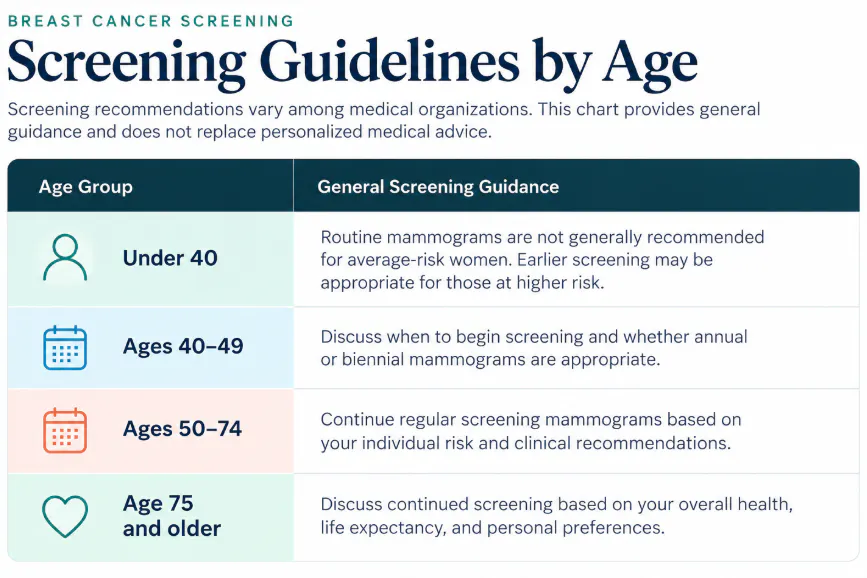
Screening recommendations vary among medical organizations. This chart provides general guidance and does not replace personalized medical advice.
Types of Breast Cancer Screening Tests
Different tests may be recommended depending on your age, breast density, medical history, and individual risk.
Screening Mammograms
A mammogram is a low-dose X-ray of the breast used to detect changes that may be too small to feel.
Screening mammograms are the primary method of breast cancer screening for most women.
They can help identify suspicious changes before symptoms develop, although no screening test detects every cancer.
CLS Health can help you understand when to schedule a mammogram and provide a referral to an imaging facility when appropriate.
Breast Ultrasound and MRI
Breast ultrasound and MRI may be recommended in certain situations.
- Breast ultrasound uses sound waves to create images of breast tissue. It is often used to evaluate a lump or an area of concern found during a mammogram.
- Breast MRI uses magnetic fields to create detailed images of breast tissue. It may be recommended as an additional screening test for women at high risk of breast cancer.
These tests do not routinely replace screening mammograms. Your healthcare professional can help determine whether additional imaging is appropriate based on your individual needs.
Clinical Breast Exams and Breast Health Evaluations
A breast health evaluation allows you to discuss your breast health, personal risk factors, and screening recommendations with a healthcare professional.
Depending on your symptoms and medical history, your visit may include a clinical breast exam to check for lumps or other changes.
Clinical breast exams do not replace screening mammograms and are not routinely recommended as a screening method for average-risk women by all medical organizations.
At CLS Health, breast health evaluations focus on understanding your concerns, reviewing your risk factors, and helping you plan appropriate next steps.
What to Expect During Your Breast Health Evaluation
Your breast health evaluation at CLS Health focuses on understanding your individual needs and helping you make informed decisions about screening.
During your visit, your healthcare professional may:
- Review your medical history. Discuss your personal health history, family history of breast or ovarian cancer, and any current breast concerns.
- Assess your breast cancer risk. Review factors such as age, family history, genetic risk, and previous breast findings.
- Recommend appropriate screening. Help determine when you should begin mammograms and how often screening may be needed.
- Coordinate imaging referrals. Provide a referral for a mammogram or additional breast imaging when appropriate.
- Discuss follow-up care. Explain the next steps, including how results and any recommended follow-up may be coordinated.
Your visit is also an opportunity to ask questions about breast changes, screening guidelines, and ways to stay informed about your breast health.
Who May Need Earlier or Additional Breast Cancer Screening?
Some women have a higher risk of developing breast cancer and may benefit from earlier or more frequent screening.
Factors that may affect your screening recommendations include:
- Family history: Having close relatives who have been diagnosed with breast or ovarian cancer.
- Inherited genetic mutations: Carrying a BRCA1, BRCA2, or other gene mutation associated with increased breast cancer risk.
- Personal history of breast cancer: Having previously been diagnosed with breast cancer.
- Certain breast findings: Having a history of specific high-risk breast tissue changes or biopsy results.
- Dense breast tissue: Having dense breasts, which can make cancers harder to detect on mammograms and may be associated with increased breast cancer risk.
Not everyone with these risk factors needs the same screening plan.
Your CLS Health clinician can review your medical and family history and help determine whether earlier mammograms, additional imaging, genetic counseling, or specialty evaluation may be appropriate.
When Should You See a Doctor About Breast Changes?
Breast cancer screening is intended for people who do not have symptoms. If you notice a new or unusual breast change, it's important to schedule a medical evaluation rather than wait for your next routine mammogram.
Contact a healthcare professional if you notice:
- A new lump or thickening in the breast or underarm
- Nipple discharge, especially if it is bloody or occurs without squeezing
- Changes in breast size, shape, or appearance
- Skin dimpling, redness, thickening, or other unusual changes
- A nipple that becomes newly inverted
- Persistent breast or nipple pain in one specific area
Many breast changes are caused by conditions other than cancer. However, new or persistent symptoms should be evaluated to determine whether additional testing is needed.
Have Questions About Your Breast Health?
Schedule a breast health evaluation with a CLS Health primary care or OB/GYN clinician.
Why Choose CLS Health for Breast Health Evaluations?
At CLS Health, breast health evaluations are focused on helping you understand your risk, navigate screening recommendations, and take the next step with confidence.
Our primary care and OB/GYN teams offer:
- Personalized breast cancer risk assessments based on your health and family history
- Individualized screening guidance that considers your age, medical history, and risk factors
- Mammogram and additional imaging referrals when appropriate
- Convenient access to primary care and OB/GYN services throughout Greater Houston
- Coordination with specialty care when additional evaluation or treatment is needed
Whether you're preparing for your first mammogram or have questions about your breast cancer risk, our team can help you understand your options and coordinate appropriate care.
Breast Health Evaluations and Mammogram Referrals in Greater Houston
CLS Health offers breast health evaluations and mammogram referrals through our primary care network across Greater Houston.
Our primary care clinicians can review your medical history, assess breast cancer risk factors, discuss screening recommendations, and help coordinate imaging referrals when appropriate.
You can also schedule a breast health evaluation with a CLS Health OB/GYN clinician for personalized guidance on breast screening and other women's health concerns.
Mammograms are performed at referred imaging facilities rather than CLS Health clinics. Your healthcare team can help guide you through the referral process and discuss recommended follow-up care.
Use our location directory to find a CLS Health primary care or OB/GYN clinician near you.
FAQs
For women at average risk, screening mammograms generally begin at age 40. Women at higher risk may need earlier screening or additional imaging. Your healthcare professional can recommend a schedule based on your personal and family medical history.
Screening frequency depends on your age, risk factors, and clinical guidelines. Some organizations recommend annual mammograms, while others recommend screening every two years. Your healthcare professional can help determine the right schedule for you.
Not always. Some imaging facilities allow patients to schedule screening mammograms without a referral, depending on facility and insurance requirements. Diagnostic mammograms may require a medical order. CLS Health can provide imaging referrals when appropriate.
A mammogram uses low-dose X-rays and is the primary breast cancer screening test for most women. A breast ultrasound uses sound waves to examine breast tissue, often to evaluate a lump or another concern. Ultrasound may complement mammography but does not routinely replace it.
Yes. Breast cancer screening helps detect cancer before symptoms develop, when treatment may be more effective. If you notice a lump, nipple discharge, or other unusual breast changes, schedule a medical evaluation rather than waiting for routine screening.
Many insurance plans cover recommended screening mammograms at no out-of-pocket cost when coverage requirements are met. Diagnostic testing or additional imaging may involve separate costs. Contact your insurance company to confirm your benefits and any expected expenses.
Schedule a Breast Health Evaluation in Houston
Taking care of your breast health starts with understanding your individual risk and knowing when to schedule recommended screenings.
At CLS Health, our primary care and OB/GYN teams can help you review your breast cancer risk factors, discuss screening recommendations, and coordinate mammogram referrals when appropriate.
Whether you're due for a routine mammogram, have questions about your family history, or want guidance on breast health, we're here to help you take the next step.
Book with Dr. Campos

Obstetrics and Gynecology