

Living with a food allergy can make everyday activities stressful, from grocery shopping to eating at restaurants. If you're looking for ways to manage food allergies, you may have heard about food allergy drops.
Food allergy drops, also called sublingual immunotherapy (SLIT), are being studied as a way to help the immune system become less sensitive to certain food allergens.
At CLS Health, our allergists can review your allergy history, symptoms, and test results to help you understand your treatment options. Food allergy drops are not a cure and should only be considered under the guidance of a qualified allergist.
Key Takeaways
Food allergy drops are being studied to help the body become less sensitive to certain food allergens.
Food allergy drops are not a cure. Patients must still avoid foods that trigger reactions and follow their allergy care plan.
Serious allergic reactions, including anaphylaxis, are possible, so medical supervision is essential.
An allergist can review your allergy history and test results to help find the right treatment approach for you.
What Are Food Allergy Drops?
Food allergy drops are a form of immunotherapy that involves placing carefully measured amounts of food allergen under the tongue. The goal is to help the immune system become less sensitive to that allergen over time.
Unlike medications that manage allergy symptoms, immunotherapy aims to change how the immune system responds to an allergen.
Are Food Allergy Drops FDA Approved?
No. There are currently no FDA-approved sublingual immunotherapy (SLIT) products for treating food allergies. Food allergy drops are still being studied for their potential to reduce sensitivity to certain food allergens.
However, other FDA-approved food allergy treatments are available for eligible patients. These include omalizumab (Xolair), which helps reduce the risk of allergic reactions from accidental exposure to certain foods. Unlike allergen immunotherapy, omalizumab does not directly train the immune system to tolerate increasing amounts of a food allergen.
Food SLIT aims to help the immune system become less reactive to specific allergens, but its effectiveness, safety, and ability to produce lasting tolerance remain under investigation.
An allergist can explain the differences between these approaches, their potential benefits and limitations, and which options may be appropriate for your individual needs.
Food Allergy Drops (SLIT) vs. Oral Immunotherapy (OIT)
Food sublingual immunotherapy (SLIT) and oral immunotherapy (OIT) are two approaches used or studied to help reduce sensitivity to certain food allergens. Both involve carefully controlled exposure to food allergens under medical supervision, but they differ in how allergens are administered and the treatment protocols involved.
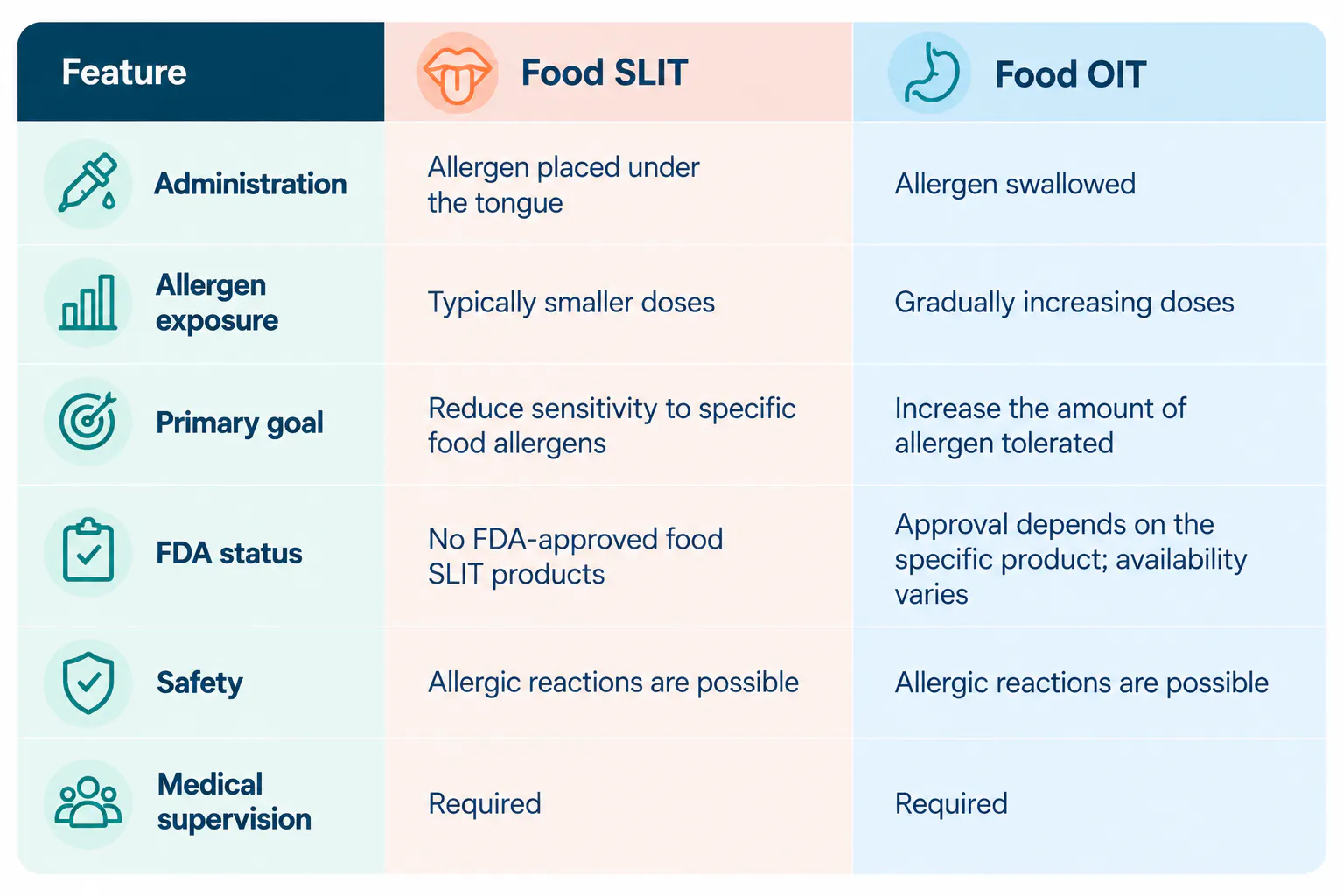
- Food SLIT involves placing small, carefully measured amounts of food allergen under the tongue. This approach allows allergists to begin with very small doses, particularly for patients who are highly sensitive to certain foods.
- Food OIT involves consuming gradually increasing amounts of a food allergen under the guidance of an allergist. The goal is to increase the amount of allergen a patient can tolerate while receiving treatment.
At CLS Health, food SLIT may serve as an initial step toward real-food OIT for selected patients. After completing a SLIT protocol, some patients may be able to transition to larger amounts of food allergens through OIT.
Neither approach guarantees permanent tolerance or eliminates the need for allergy precautions. Treatment plans depend on each patient's allergy history, response to treatment, and individual goals.
How Do Food Allergy Drops Work?
Food allergy drops use small, carefully measured amounts of food allergens placed under the tongue to help the immune system become less reactive over time. This process, called desensitization, aims to increase the amount of an allergen a person can tolerate while receiving treatment.
Think of food SLIT as a gradual way of training the immune system to respond differently to a food allergen. For patients with greater sensitivity, treatment may begin with very small doses before progressing to larger amounts through oral immunotherapy (OIT), when appropriate.
Treatment goals vary from patient to patient. Some may eventually tolerate larger amounts of a food, while others may achieve a level of desensitization that increases their reaction threshold, potentially reducing the risk of allergic reactions from accidental exposure.
Results are not guaranteed, and patients should continue following their prescribed food allergy management and emergency action plans.
How Do I Start Food Allergy Drops?
If you're considering food allergy drops, the first step is a consultation with an allergist. Your provider will review your allergy history, evaluate your symptoms, and discuss whether food sublingual immunotherapy (SLIT) or another treatment approach may be appropriate.
1. Food Allergy Evaluation
Your allergist reviews your suspected food triggers, previous allergic reactions, medical history, and treatment goals to better understand your individual needs.
2. Allergy Testing
Skin prick tests or blood tests may help identify potential food allergens. Your allergist will interpret these results alongside your medical history, since a positive test alone does not confirm a food allergy.
3. Personalized Treatment Discussion
Your allergist explains available management and treatment options, including the potential benefits, risks, and limitations of food SLIT and oral immunotherapy (OIT), when appropriate.
4. Treatment Planning and Monitoring
If food SLIT is considered appropriate, your allergist will explain the treatment process, safety precautions, and follow-up requirements. You'll also learn how to recognize allergic reactions and when to seek emergency care.
Who May Be a Candidate for Food Allergy Drops?
Whether food allergy drops are appropriate depends on your individual allergy history and risk factors.
Factors your allergist may consider include:
- Your specific food allergy and previous reactions
- Allergy testing results
- Age and overall health
- Ability to follow treatment instructions
- Risk of severe allergic reactions
- Ability to attend follow-up appointments
Your allergist can help determine whether food allergy drops, oral immunotherapy, or another management approach may be appropriate.
Food Allergy Drops for Children
For parents of children with food allergies, finding safe ways to manage allergic reactions is especially important.
Food allergy drops have been studied in children, but they are not appropriate for every child.
An allergist will consider your child's age, allergy history, previous reactions, test results, and overall health before discussing treatment options.
Parents and caregivers should also understand potential side effects, safety precautions, and what to do in an emergency.
Are Food Allergy Drops Safe?
Food allergy drops can cause allergic reactions, so medical supervision is essential.
Possible side effects include:
- Itching or irritation in the mouth or throat
- Tingling or swelling of the lips or tongue
- Stomach discomfort
- Other allergic reactions
In some cases, severe allergic reactions, including anaphylaxis, can occur.
An allergist can explain the risks, recommend appropriate precautions, and determine whether you need an epinephrine auto-injector.
What Food Allergies Can Drops Treat?
Food sublingual immunotherapy (SLIT) has been studied for certain food allergies, including peanut and milk allergies. However, research is more limited for other allergens, and treatment effectiveness and safety can vary.
Common food allergens that patients may seek treatment for include:
- Peanuts
- Tree nuts
- Milk
- Eggs
- Wheat
- Soy
- Fish
- Shellfish
- Sesame
Not every food allergy can or should be treated with food drops. Treatment depends on the specific allergen, your reaction history, and your individual risk factors.
Your allergist can review which immunotherapy options may be appropriate for your food allergies and whether food SLIT or oral immunotherapy (OIT) aligns with your treatment goals.
Food Allergy Drops Are Not a Cure
Food allergy drops aim to reduce sensitivity to specific food allergens, but treatment outcomes vary. Some patients may progress to oral immunotherapy and eventually tolerate larger amounts of their target food. Others may achieve a level of desensitization that increases the amount of allergen they can tolerate, potentially reducing the risk of reactions from accidental exposure.
However, desensitization does not guarantee permanent tolerance or eliminate the possibility of allergic reactions. Patients should continue following their allergist's instructions, including food avoidance and emergency preparedness when appropriate.
- Avoid foods that trigger allergic reactions
- Read food labels carefully
- Carry epinephrine when prescribed
- Follow your food allergy action plan
- Attend regular appointments with your allergist
Never begin eating a food you're allergic to without specific guidance from your allergist.
Food Allergy Drops vs. Other Food Allergy Treatment Options
Managing food allergies involves more than choosing an immunotherapy treatment. Depending on your allergy history, symptoms, and risk factors, your allergist may recommend several approaches:
- Allergen Avoidance: Identifying and avoiding foods that trigger allergic reactions.
- Emergency Preparedness: Developing a food allergy action plan and carrying prescribed epinephrine when appropriate.
- Oral Food Challenges: Medically supervised testing to confirm a suspected food allergy or determine whether an existing allergy has resolved.
- Food Allergy Immunotherapy: Discussing options such as food SLIT or oral immunotherapy (OIT), including their potential benefits, risks, and limitations.
Your allergist can help determine which approaches are appropriate for your individual needs and develop a personalized food allergy management plan.
Find Out if Food Allergy Drops Are Right for You
A CLS Health allergist can review your allergy history, explain available treatments, and help you understand your options.
Why Choose CLS Health for Food Allergy Drops?
At CLS Health, our allergists provide personalized food allergy evaluations and treatment options, including food sublingual immunotherapy (SLIT) and oral immunotherapy (OIT) for eligible patients.
Dr. Jonathon Schening offers these treatments at our Clear Lake and Houston Galleria allergy clinics. Treatment plans are individualized based on each patient's allergy history, sensitivity, and goals, with careful monitoring and ongoing guidance.
Our allergy care includes:
- Board-certified allergists and immunologists
- Comprehensive food allergy evaluations and testing
- Personalized food SLIT and OIT treatment planning
- Guidance on food and environmental allergy management
- Safety planning and emergency preparedness
- Ongoing monitoring and follow-up
- Convenient locations throughout Greater Houston
As a physician-led, multispecialty medical group, CLS Health can also help coordinate care with other specialties when needed.
Meet Jonathon Schening, MD
Jonathon Schening, MD, is a board-certified allergist and immunologist who provides personalized allergy care for children and adults.
He is also board-certified in pediatrics and completed fellowship training in Allergy and Clinical Immunology at Baylor College of Medicine and Texas Children's Hospital.
Dr. Schening takes an evidence-based approach to allergy care, helping patients understand their allergies and develop treatment plans based on their individual needs.
He sees patients at CLS Health Allergy & Immunology locations in Clear Lake and Houston Galleria.
Food Allergy Drops in Greater Houston
CLS Health provides allergy evaluations and treatment options at locations throughout Greater Houston. Dr. Jonathon Schening offers food sublingual immunotherapy (SLIT) and oral immunotherapy (OIT) for eligible patients at our Clear Lake and Houston Galleria clinics.
Our additional Allergy & Immunology locations also offer allergy drops. Treatment options and availability may vary by provider and location.
Webster
CLS Health Allergy & Immunology — Clear Lake
Serving patients in Webster, Clear Lake, League City, Friendswood, Nassau Bay, Seabrook, and surrounding communities.
Uptown Houston
CLS Health Allergy & Immunology — Houston Galleria
Serving patients in Houston, West University, Bellaire, River Oaks, Greenway Plaza, and surrounding communities.
Houston Heights
CLS Health Allergy & Immunology — Greater Heights
Serving patients in Greater Heights, Garden Oaks, Oak Forest, The Heights, North Houston, and surrounding communities.
Cypress
CLS Health Allergy & Immunology — North Cypress
Serving patients in Cypress, Towne Lake, Bridgeland, Fairfield, Jersey Village, Copperfield, and surrounding communities.
FAQs
Food allergy drops are placed under the tongue, while allergy shots are injections commonly used to treat environmental allergies. The treatments have different uses and safety considerations.
Coverage varies by insurance plan. Because food allergy drops are not FDA-approved for food allergies, coverage may be limited. Contact your insurance company and CLS Health to discuss potential costs.
No. Continue avoiding foods that trigger allergic reactions unless your allergist advises otherwise. Food allergy drops may increase your tolerance over time, but allergic reactions remain possible. Never introduce an allergenic food without your allergist's guidance.
Treatment timelines vary based on the food allergen, your sensitivity, and response to treatment. Some patients may transition from food SLIT to oral immunotherapy (OIT). Your allergist will develop a personalized treatment plan and discuss the expected timeline.
Schedule a Food Allergy Consultation in Houston
Managing food allergies can feel overwhelming, but you don't have to figure it out alone.
At CLS Health, our allergists can help identify your food allergy triggers, evaluate your risk factors, and discuss treatment options tailored to your needs.
Whether you're curious about food allergy drops or looking for ways to manage allergic reactions, our team is here to help.
Book with Dr. Schening

Allergy and Immunology