

Key Takeaways
ADHD and autism are different conditions, but they can share similar behaviors—especially in young children.
Diagnosis is based on patterns over time, not a single behavior or moment.
Early, comprehensive evaluation provides clarity and helps families access the right support sooner.
Parents often ask whether their child’s behaviors point to ADHD, autism, or something else entirely. This question is both common and understandable. Many children show traits—like high energy, short attention spans, or social challenges—that overlap between the two conditions. While ADHD and autism are distinct diagnoses, they can appear similar at certain ages, especially in toddlers and preschoolers.
Understanding the differences between ADHD vs autism helps parents recognize when it may be time to seek professional guidance. More importantly, it shifts the focus from isolated behaviors to developmental patterns over time—which is how clinicians truly evaluate children.
ADHD vs Autism — A Quick Overview
Both attention-deficit/hyperactivity disorder (ADHD) and autism spectrum disorder (ASD) are neurodevelopmental conditions, meaning they affect how a child’s brain develops and functions.
- What is ADHD?
ADHD primarily affects attention, impulse control, and activity levels. Children with ADHD may struggle to stay focused, sit still, or think before acting. - What is autism?
Autism spectrum disorder primarily affects social communication, behavioral patterns, sensory processing, and flexibility with change.
Key difference: While both conditions can affect behavior and learning, ADHD and autism impact development in different ways, and symptoms may overlap or change as children grow.
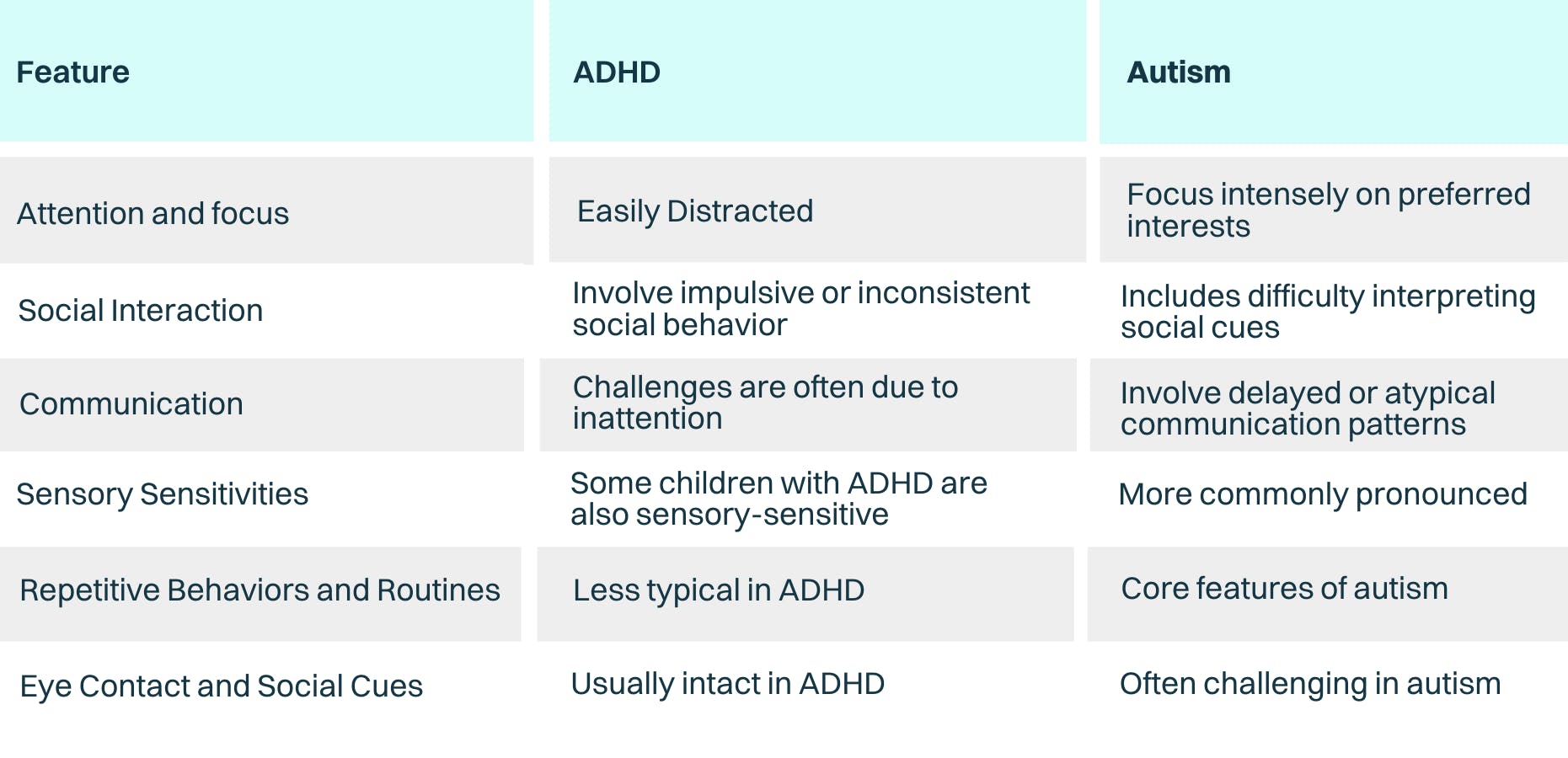
ADHD vs Autism in Children Chart — Side-by-Side Comparison
When parents compare ADHD vs autism, they often notice differences across several developmental areas:
- Attention and focus: Children with ADHD are easily distracted, while autistic children may focus intensely on preferred interests.
- Social interaction: ADHD may involve impulsive or inconsistent social behavior; autism often includes difficulty interpreting social cues.
- Communication: ADHD-related challenges are often due to inattention, whereas autism may involve delayed or atypical communication patterns.
- Sensory sensitivities: More commonly pronounced in autism, though some children with ADHD are also sensory-sensitive.
- Repetitive behaviors and routines: Core features of autism; less typical in ADHD.
- Eye contact and social cues: Often challenging in autism; usually intact in ADHD.
This ADHD vs autism chart-style comparison highlights common patterns—not diagnostic criteria. A child does not need to fit every category to receive a diagnosis.
ADHD vs Autism in Toddlers — What Parents Often Notice
Distinguishing ADHD from autism in toddlers can be especially difficult. Young children naturally have short attention spans, big emotions, and developing communication skills. Common overlapping behaviors include tantrums, delayed speech, high activity levels, and difficulty following directions.
In younger children, behaviors more suggestive of autism may include limited eye contact, reduced social engagement, repetitive play, or strong sensory reactions. ADHD-related behaviors may show up as extreme impulsivity, constant motion, or difficulty sustaining attention even during preferred activities.
It’s important to remember: early behaviors are not diagnoses. Evaluations focus on developmental patterns over time—not single moments or phases.
Can a Child Have Both ADHD and Autism?
Yes. ADHD and autism frequently co-occur. One diagnosis does not rule out the other, and many children meet criteria for both conditions. This is why comprehensive evaluation matters—without it; one condition may be overlooked, leading to incomplete support.
When to Consider Autism Testing or ADHD Evaluation
Parents often seek evaluation when they notice:
- Concerns raised by teachers or daycare providers
- Speech delays or limited social interaction
- Difficulty following instructions or staying on task
- Extreme rigidity, repetitive behaviors, or strong sensory reactions
- Persistent attention or behavior challenges lasting several months despite routine support
Trusting your instincts as a parent is important. If concerns persist, a developmental evaluation can provide clarity.
How ADHD and Autism Are Evaluated
There is no single test that diagnoses ADHD or autism. Evaluations typically include:
- Developmental and medical history
- Parent and teacher input
- Standardized screening and assessment tools
Medical evaluations differ from school-based screenings and are designed to look at the whole child—not just classroom performance. The goal is clarity and guidance, not labels.
Why See a Pediatrician with Expertise in ADHD and Autism
A pediatrician with developmental and behavioral expertise can:
- Provide a medical diagnosis rather than therapy-only assessments
- Evaluate overlapping developmental and behavioral conditions
- Coordinate care with schools, therapists, and specialists
- Guide families on next steps after evaluation
ADHD & Autism Evaluations for Sugar Land and Webster Families
Families seeking ADHD testing or autism evaluations near Houston—including Sugar Land and Webster—benefit from early, supportive, and family-centered care. These evaluations are designed to understand your child, address developmental and behavioral concerns without judgment, and provide clear guidance and ongoing support for the next steps.
What Happens After a Diagnosis?
A diagnosis provides understanding, not limitation. Families receive individualized care plans, recommendations for therapies or school accommodations when appropriate, and ongoing follow-up as a child grows and their needs evolve.
Schedule an ADHD or Autism Evaluation Today
If you’re unsure whether your child’s behaviors reflect ADHD, autism, or typical development, a comprehensive evaluation can help provide clarity. Early, thoughtful guidance from CLS Health Pediatric Associates helps families understand what’s happening and identify the right next steps with confidence and support.
Ready to get answers? Schedule an ADHD or autism evaluation today.