

Key Takeaways
Accurate ADHD testing looks at patterns over time—not isolated behaviors or online checklists.
Comprehensive, physician-led evaluations help distinguish ADHD from anxiety, learning differences, or autism.
Early evaluation supports better outcomes and helps families move forward with clarity and confidence.
If you’re noticing ongoing challenges with focus, behavior, or school performance, it’s natural to wonder whether ADHD could be a factor. Attention-deficit/hyperactivity disorder (ADHD) is common, highly treatable, and often misunderstood. Accurate testing can provide clarity, reassurance, and a clear path forward.
Our pediatricians provide ADHD testing for toddlers, children, and teens, serving Houston-area families through our Sugar Land and Webster locations. These evaluations are comprehensive and physician-led—going beyond quick online tests or school screenings alone.
What Is ADHD Testing?
ADHD testing is a comprehensive evaluation that reviews a child's behavior, development, medical history, and input from parents and teachers. There is no single ADHD test. Diagnosis is based on DSM-5 criteria and helps determine whether symptoms are caused by ADHD or another condition, such as anxiety, learning differences, or autism.
What Is ADHD?
ADHD is one of the most common neurodevelopmental conditions in children and often continues into adolescence and adulthood. Symptoms typically begin before age 12 and can affect school performance, relationships, and daily functioning. Children and teens with ADHD may have difficulty focusing, sitting still, organizing tasks, or thinking before acting.
You may also hear the term ADD vs ADHD. ADD is an older term that is now included under ADHD. Today, ADHD is the correct and inclusive medical diagnosis.
Importantly, ADHD is not caused by poor parenting, lack of discipline, or a child not trying hard enough. It reflects differences in brain development and function.
Common ADHD Symptoms in Children and Teens
ADHD symptoms can vary widely by age, setting, and individual child. Not every child experiences every symptom.
Inattention
- Difficulty focusing or sustaining attention
- Forgetfulness or frequently losing items
- Trouble completing tasks or following instructions
Hyperactivity
- Excessive movement or restlessness
- Difficulty staying seated
- Talking excessively
Impulsivity
- Interrupting others
- Acting without thinking
- Difficulty waiting or taking turns
Symptoms may appear at home, school, or both—and may change as children grow.
Types of ADHD
Clinically, there are three recognized types of ADHD:
Predominantly Inattentive Type
Children with this type primarily struggle with attention, organization, following instructions, and completing tasks. They may seem forgetful, easily distracted, or appear to be daydreaming.
Predominantly Hyperactive-Impulsive Type
This type is characterized by excessive movement, fidgeting, difficulty sitting still, frequent talking, interrupting others, or acting before thinking.
Combined Type
The most common presentation, combined type includes symptoms of both inattention and hyperactivity-impulsivity that affect daily functioning across multiple settings.
You may see references online to "seven types of ADHD," but medically, diagnosis is based on these three recognized presentations. Even within these classifications, ADHD symptoms and severity can vary from one child to another.
When Should Your Child Be Tested for ADHD?
Parents may consider ADHD testing for their child when they notice:
- Ongoing concerns raised by teachers or school staff
- Difficulty completing tasks or following instructions
- Behavioral challenges at home, school, or daycare
- Falling behind academically despite effort
- Symptoms overlapping with anxiety, learning differences, or autism
If challenges persist and interfere with daily functioning, testing can help clarify what support is needed.
Can Toddlers Be Tested for ADHD?
While some ADHD-related behaviors may appear during the preschool years, diagnosing ADHD in toddlers is often more challenging because many young children naturally have short attention spans and high activity levels. A developmental-behavioral pediatrician can determine whether behaviors are age-appropriate or whether further evaluation is appropriate.
How ADHD Testing Works
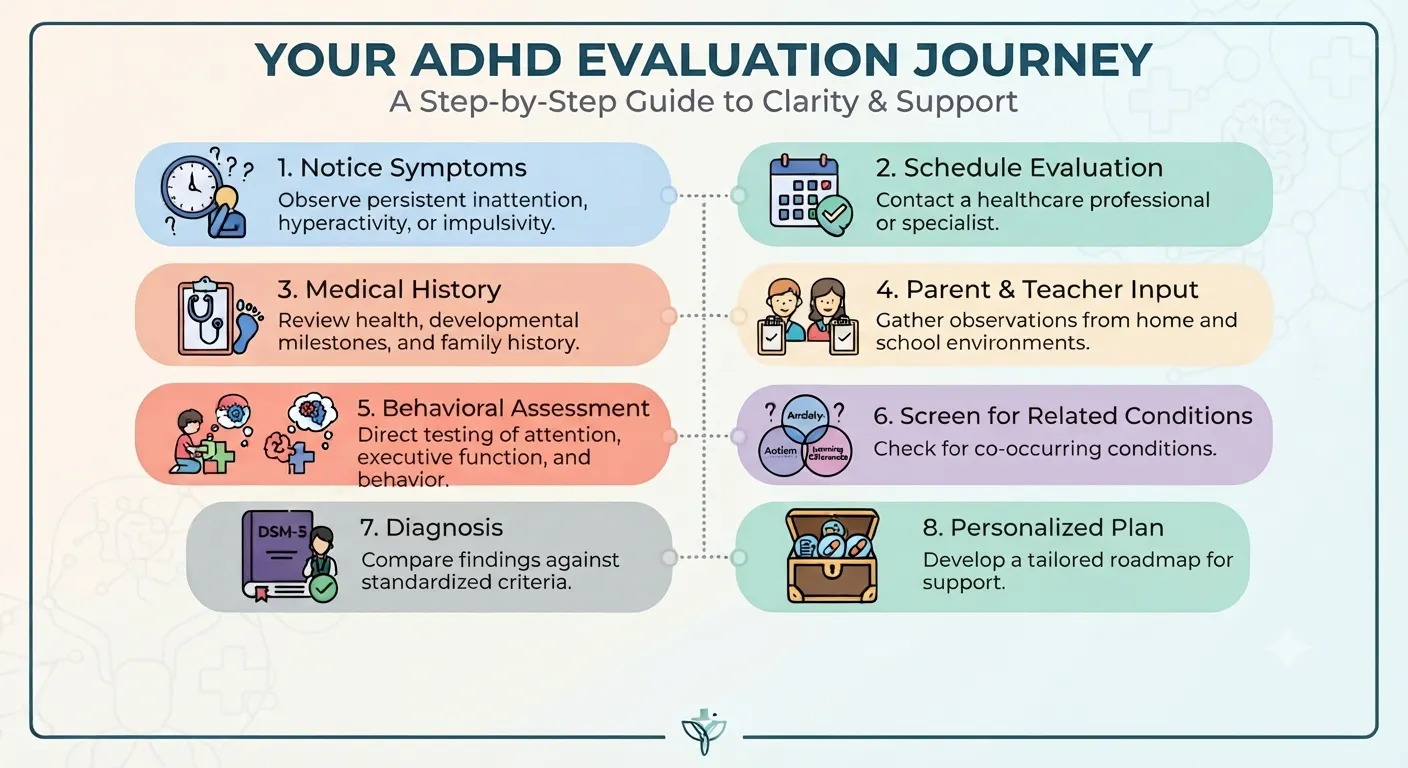
There is no single test that diagnoses ADHD. Instead, ADHD testing involves a comprehensive, individualized evaluation that may take more than one visit to ensure accuracy.
The evaluation typically includes:
- A detailed medical and developmental history
- Parent and teacher questionnaires
- Review of academic, behavioral, and developmental patterns
- Screening for learning differences, anxiety, or autism
- Diagnosis is based on the Diagnostic and Statistical Manual of Mental Disorders (DSM-5) criteria, along with medical history, behavioral observations, and information gathered from parents and teachers.
Because ADHD symptoms can overlap with anxiety, depression, learning disabilities, sleep disorders, hearing or vision problems, and autism, a comprehensive evaluation is essential before making a diagnosis.
There is no blood test or brain scan for ADHD. The goal is understanding—not rushing to a label.
Get Answers with a Comprehensive ADHD Evaluation
Every child is different, which is why ADHD testing should go beyond a simple checklist. Our developmental-behavioral pediatricians provide thorough evaluations to identify ADHD and distinguish it from other conditions with similar symptoms, helping families move forward with clarity and confidence.
FAQs
Most ADHD evaluations take one or more appointments, depending on your child's age, symptoms, and medical history. Additional questionnaires or information from teachers may also be reviewed before a diagnosis is made.
Children can be evaluated whenever persistent symptoms begin affecting learning, behavior, or daily life. Although ADHD can sometimes be identified in preschool-aged children, evaluations are often performed once symptoms become consistent across multiple settings, such as home and school.
No. There is no blood test, brain scan, or laboratory test that can diagnose ADHD. Diagnosis is based on a comprehensive clinical evaluation using established DSM-5 criteria, medical history, behavioral observations, and input from parents and teachers.
Some children may receive a diagnosis after one comprehensive evaluation, while others require additional visits or information from parents, teachers, or other specialists. The goal is an accurate diagnosis rather than a rushed one.
Many insurance plans cover medically necessary ADHD evaluations, although coverage varies by provider and plan. Our team can help verify your benefits before your appointment.
Who Can Diagnose ADHD?
ADHD can be diagnosed by several qualified healthcare professionals, including developmental-behavioral pediatricians, pediatricians with experience evaluating ADHD, child psychologists, child psychiatrists, and neurologists. At CLS Health, ADHD evaluations are performed by developmental-behavioral pediatricians who assess medical, developmental, behavioral, and learning factors before making an accurate diagnosis.
ADHD Testing with a Developmental Pediatrician
A developmental behavioral pediatrician specializes in evaluating developmental, behavioral, and learning concerns in children and teens.
This specialized care offers:
- Medical diagnosis rather than school-based screening alone
- Evaluation of overlapping developmental and behavioral conditions
- Authority to diagnose ADHD and guide treatment
- Coordination with schools, therapists, and other specialists
ADHD and Autism — Understanding the Overlap
ADHD and autism can occur together, and some symptoms overlap. Without careful evaluation, one condition may be missed or misunderstood.
Comprehensive ADHD testing helps identify whether a child has ADHD, autism, both, or another developmental difference—ensuring the right supports are put in place.
After the ADHD Evaluation — What Comes Next?
A diagnosis is meant to clarify needs and necessary support, not label a child.
After the evaluation, families receive:
- A clear diagnosis or ruling out of ADHD
- Personalized recommendations
- School support documentation when appropriate
- Guidance on treatment options, which may include behavioral strategies, parent education, or medication when indicated
Ongoing follow-up allows care to adapt as your child grows.
ADHD Testing Near Houston
Families throughout Houston, Sugar Land, Webster, Missouri City, Richmond, Pearland, Katy, and surrounding communities choose CLS Health for physician-led ADHD evaluations designed to provide clear answers and personalized treatment recommendations.
We proudly serve Houston-area families from our Sugar Land and Webster locations, with an emphasis on continuity of care and collaboration with schools and specialists.
Why Choose CLS Health ADHD Testing Services?
Families choose our practice for:
- Developmental pediatric expertise
- Evidence-based evaluation tools
- Experience with complex developmental profiles
- A supportive, nonjudgmental, family-centered approach
Schedule an ADHD Evaluation in Sugar Land or Webster
If you're concerned about your child's focus, behavior, or school performance, our developmental pediatricians provide comprehensive ADHD evaluations that help families understand what's happening and what to do next. Schedule an appointment today to receive personalized guidance and evidence-based care.
Book with Dr. Mohammed

Pediatrics, Primary Care