Open Enrollment mistakes may not feel like mistakes when you’re making them. Choosing the lowest premium, letting your current plan renew, or assuming your doctor is still in-network can all seem reasonable until costs or coverage surprises show up later.
Many health insurance decisions are based on information that may be incomplete, outdated, or misunderstood. Before choosing coverage for the coming year, here are seven common Open Enrollment myths — and the facts to know before you compare plans.
Key Takeaways
The lowest monthly premium may not be the lowest total yearly cost.
Marketplace plans, provider networks, prescription coverage, and financial assistance can change each year.
If Marketplace coverage is not available, options like Special Enrollment Periods, Medicaid, CHIP, or CLS Health self-pay may still help with access to care.
Common Open Enrollment Myths
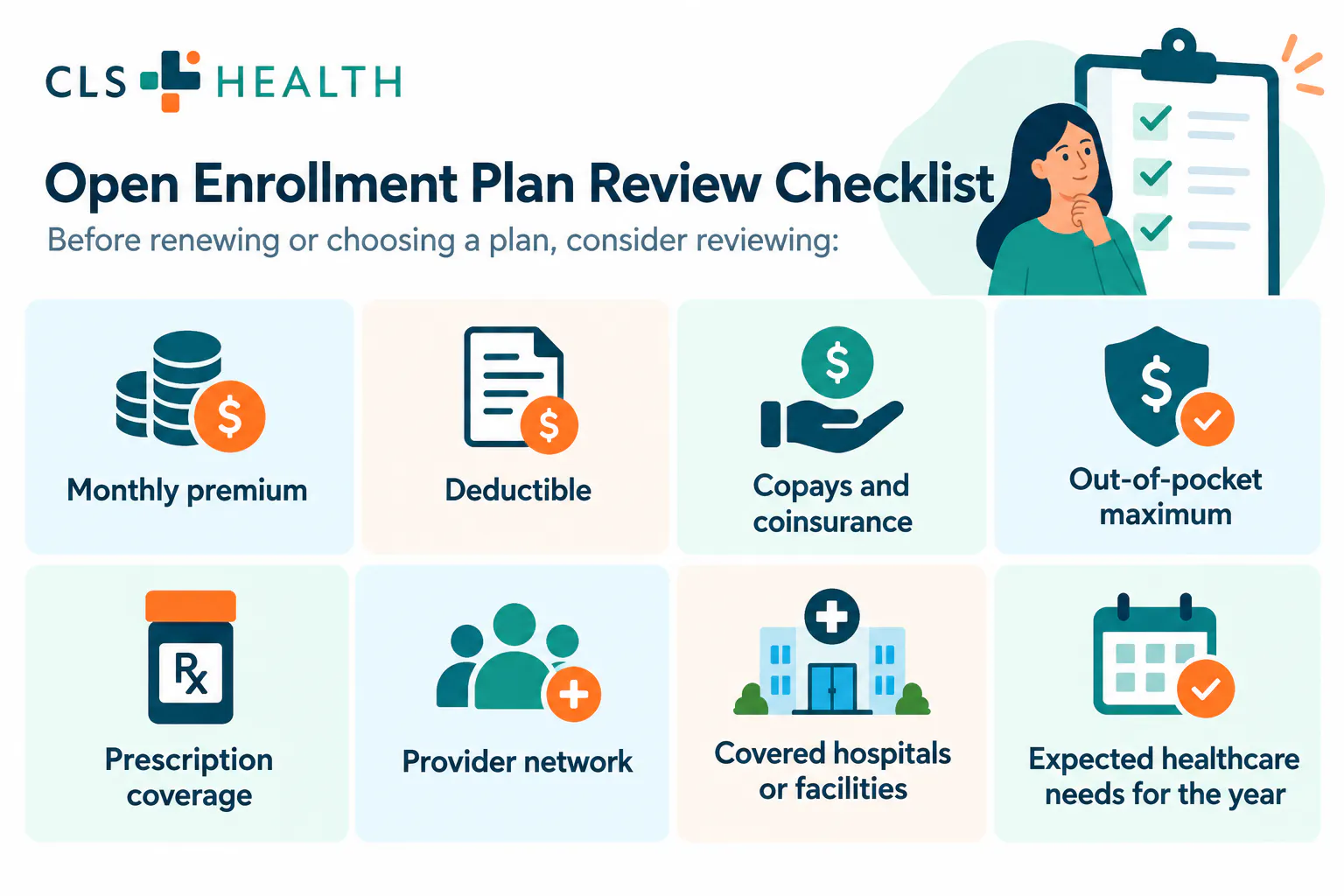
Before reviewing the myths, it may help to know which plan details are worth comparing. Use this checklist as a quick guide when reviewing Marketplace options.
Myth 1: "Marketplace coverage is only for people who are unemployed."
Having a job does not automatically prevent someone from enrolling in a Marketplace plan. Some employers do not offer health insurance, and employed individuals can still explore Marketplace options.
However, access to financial assistance may be affected by the coverage offered through an employer. Eligibility and savings also depend on factors such as household income and household size.
The Reality: Employment status is only one part of the picture. You may want to check your eligibility rather than assuming the Marketplace is not an option.
Myth 2: "The plan with the lowest premium is the best deal."
A low monthly premium may look like the most affordable choice, but it does not reveal a plan's total cost. Lower-premium plans may come with higher deductibles, copayments, coinsurance, or out-of-pocket limits.
You may also want to consider the plan's prescription drug coverage, provider network, and the healthcare services you expect to use.
The reality: The lowest premium does not always mean the lowest overall cost. You may want to compare what you may pay throughout the entire year.
Myth 3: "If I already have a plan, I don't need to review it again."
Some Marketplace plans may renew automatically, but that does not necessarily mean everything will remain the same.
Premiums, benefits, prescription drug coverage, provider networks, and financial assistance can change from year to year. Your income, household size, medications, and healthcare needs may change too.
The reality: You may want to review your plan and update your Marketplace application before renewing or accepting automatic re-enrollment.
Myth 4: "If my doctor was in-network last year, they'll be in-network this year."
Provider networks can change annually. A physician, hospital, or healthcare organization that participated in your plan last year may not participate in it this year. Plans offered by the same insurance company can also have different networks.
Depending on the plan, nonemergency care outside the network may cost more or may not be covered.
The reality: You may want to check the exact plan, not only the insurance company, and confirm participation with both the plan and the healthcare provider when possible.
Myth 5: "A pre-existing condition can prevent me from getting Marketplace coverage."
Good news: Marketplace plans must cover treatment for pre-existing medical conditions.
Because of a pre-existing condition, a Marketplace insurer cannot:
- Reject your application
- Charge you more
- Refuse to cover essential health benefits
Coverage details, prescription drug coverage, provider networks, and patient costs can still differ among plans.
The reality: A pre-existing condition does not disqualify you, but you may still want to compare how plans cover the care, physicians, and prescriptions you need.
Myth 6: "If I miss Open Enrollment, I have no other options."
Certain life changes may qualify you for a Special Enrollment Period. These can include losing qualifying health coverage, getting married, having or adopting a child, and making certain qualifying moves.
Losing a job does not automatically qualify someone unless it also results in the loss of qualifying coverage. Not every move qualifies either. Medicaid and the Children's Health Insurance Program (CHIP) also accept applications throughout the year for people who are eligible.
The reality: You may not want to assume you must wait until next year. Consider checking whether your circumstances provide another enrollment opportunity.
So, what if Open Enrollment has passed, a Special Enrollment Period doesn't apply, and Marketplace coverage genuinely isn't an option right now? It may not be the dead end that it seems to be.
Myth 7: "If I don't get Marketplace coverage, my only option is to go without care."
Being uninsured does not necessarily mean going without routine care.
CLS Health offers self-pay options that allow patients to pay directly for certain services without using insurance.
Self-pay is not health insurance and does not offer the same financial protection for emergencies, hospitalizations, or other major medical expenses. It can, however, provide another way to access certain services when a patient is uninsured or chooses not to use insurance.
The reality: CLS Health's self-pay options may make certain routine services more accessible, with no Open Enrollment window required.
Not sure how self-pay compares with using insurance? We break it down here, learn how CLS Health self-pay options work.
FAQs About Open Enrollment Myths
You may want to review your Marketplace plan each year because premiums, benefits, prescription coverage, provider networks, and financial assistance can change.
Not always. A lower premium may come with higher deductibles, copayments, coinsurance, or out-of-pocket costs. It may help to compare the plan’s total estimated yearly cost.
Marketplace plans must cover treatment for pre-existing conditions. However, coverage details, provider networks, prescription coverage, and patient costs can vary by plan.
You may qualify for a Special Enrollment Period after certain life changes, such as losing qualifying coverage, getting married, having or adopting a child, or making certain qualifying moves.
If Marketplace coverage is not available or does not fit your situation, you may still have options for certain routine services. CLS Health offers self-pay options for eligible services, but self-pay is not health insurance.
Still Have Questions About Care Options?
Choosing health coverage can be complicated, especially when plan details, provider networks, costs, and coverage rules change from year to year. If you receive care at CLS Health, you may review available patient resources or contact our team for general information about care access, accepted insurance, and self-pay options.
For help choosing or enrolling in a Marketplace plan, contact a licensed insurance agent, broker, Marketplace navigator, or visit HealthCare.gov.
Disclaimer: This article is for general informational purposes only and does not constitute legal advice, financial advice, insurance advice or enrollment assistance. CLS Health is not a licensed insurance agent or broker and does not recommend, sell, or assist with enrollment in specific Marketplace plans.